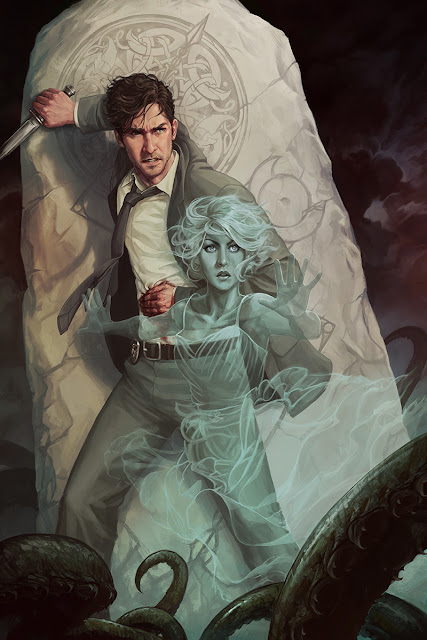
Questa è un'ospitata per una bellissima regola scritta da Gianluca, che ho costretto a passarmela in modo da pubblicarla per non fare sì che rimanesse lì a prendere bit.
▲▼▲
Regola Opzionale: Il Fantasma
SEI MORTO, sei in mezzo al dungeon, scegli:
Hai fatto colpo su uno dei tuoi Sottoposti, prendine il controllo.
La tua anima si artiglia al mondo dei vivi, diventi un Fantasma.
Giocare come un Fantasma
Scegli un tuo alleato (Recipiente) a cui legare la tua anima, se muore puoi sceglierne un altro. Non puoi allontanarti dal tuo Recipiente per più di una stanza.
Sei immateriale, invisibile e inudibile per tutti tranne che per il tuo Recipiente e altre creature eteree.
Puoi muovere oggetti come una brezza leggera, passare attraverso le pareti e fluttuare.
A fine sessione o quando desideri, svanisci nell'etere.
Opzionale: Poteri Speciali
Prima di scomparire nel regno dei morti puoi, per tante volte quanto il tuo livello:
Aiutare un compagno facendogli ritirare un tiro fallito (una sola volta per tiro).
Spostare un oggetto pesante come un grosso libro.
Assorbire metà del danno subito da un compagno.
Creare un effetto (un suono, una visione, un odore) orribile e spaventoso. Dura solo pochi attimi.
Spero la regola vi piaccia tanto come piace a me, e credo che nelle mie sessioni la userò (se non addirittura la ruberò per il mio Canaglie del Bizzarro).
Questa è una semplice regola/procedura, ispirata dalla tabella delle Scoperte,
per gestire la distribuzione delle dicerie ai giocatori.
L'ho creata perché le procedure mi piacciono, e perché mi aiutano a
focalizzarmi sul gioco anziché pensare come gestire certe questioni sulle
quali mi sento sempre troppo insicuro.
◈ ◈ ◈
All'arrivo ad una Destinazione un eroe effettua un tiro gratuito su questa
tabella prima di fare il tiro delle Scoperte (il perché è spiegato sotto).
d20
Test pertinente (Carisma)
1-10
nessuna diceria
11-12
una diceria di un'altra destinazione
12-15
una diceria
16-19
due dicerie
20+
tre dicerie
Quando ci si trova a una Destinazione un unico eroe può, come azione, chiedere in giro per ulteriori dicerie.
Se l'eroe spende una settimana intera e d6×10€ ottiene vantaggio al tiro.
Le dicerie riguardano la Destinazione in cui ci si trova. Si possono chiedere dicerie riguardanti Destinazioni remote (fino a tre una di seguito all'altra) tirando con svantaggio.
Le dicerie possono anche fare riferimento alle Scoperte, ma non indicano dove si trovano.
Quando si cercano le Scoperte si può decidere di individuare quelle relative
alle dicerie conosciute.
◈ ◈ ◈ ◈ ◈ ◈ ◈ ◈ ◈
— Rumors and Discoveries —
This is a simple rule/procedure, inspired by the Discoveries table, to manage how to give rumors to the players.
I created it because I like procedures and because they help me to focus on the game and on gming instead of thinking how to manage some aspects that I'm always insecure of myself.
◈ ◈ ◈
When the caravan arrives at a Destination, one hero makes a free relevant test on this table before testing for Discoveries (the reason is explained below).
d20
Relevant test (Charisma)
1-10
no rumors
11-12
one rumor from another destination
13-15
one rumor
16-19
two rumors
20+
three rumors
When stopped at a Destination a single hero can, as an action, ask around for additional rumors.
If the hero spends an entire week and d6×10€ they gain advantage to the roll.
Rumors are usually related to the Destination where the caravan is at.
Rumors regarding remote Destinations (up to three in a chain) can be asked about rolling with disadvantage.
Rumors can concern Discoveries, but they do not point at their location.
When searching for Discoveries, the hero may choose to locate those concerned by the known rumors.
Le armi da fuoco nei GdR fantasy sono spesso malviste, considerate troppo
"fuori genere" e decisamente sbilanciate. Ma chi lo ha detto che debba essere
davvero così?
Dopotutto il cosiddetto "fantasy classico" a là D&D non è altro che un mischione di roba e tecnologia che va dal medioevo al rinascimento!
Queste regole derivano da quelle presenti nel regolamento
Lamentations of the Flame Princess ma sono state semplificate offrendo, come da tradizione OSR, scelte
interessanti per i giocatori senza che siano quella ovvia rispetto alle altre armi già presenti nei vari altri regolamenti.
Le regole originali di Lamentations, purtroppo solo in inglese, sono comunque
interessantissime da leggere in quanto contengono molti dettagli tecnici e
storici sulle armi da fuoco seicentesche, che sono poi la base per queste regole.
Trovate il manuale nella sua versione gratuita
a questo link.
† † †
Armi da Fuoco
Arma da Fuoco
Prezzo
Città / Rurale
Danno
Gittata
Breve / Media / Lunga
Ingombro equivalente
Pistola
25ma / 50ma
1d8
25' / 50' / 100'
mazza
Archibugio
30ma / 50ma
1d8
50' / 100' / 600'
spada
Moschetto
40ma / 80ma
1d8
50' / 100' / 600'
spada a due mani
Si applicano le seguenti regole:
Tutte le armi da fuoco sono ad avancarica e utilizzano la pietra focaia come meccanismo di innesco.
Bersagli a gittata media causano -4 al tiro per colpire, -8 se a gittata lunga. L'uso di canne rigate dimezza le penalità, ma raddoppia il prezzo dell'arma.
Pistole e archibugi ignorano la protezione dell'armatura a gittata breve, i moschetti a qualsiasi gittata. La CA del bersaglio si considera come senza armatura + modificatore di Destrezza. Per i mostri usate il buonsenso.
Le armi da fuoco possono sparare una sola volta per combattimento (ma vedi Dodici Apostoli, sotto).
Le armi da fuoco possono essere utilizzate in mischia come armi contundenti: le pistole causano 1d4 danni, moschetti e archibugi 1d6 danni e vanno impugnati con due mani. Un risultato del tiro per colpire di 1-4 causa la rottura del meccanismo di innesco.
Lo sparo di un'arma da fuoco causa un immediato test sul Morale di qualsiasi avversario con Morale 7 o inferiore.
Un sacchetto di proiettili e un corno per la polvere nera per 20 colpi costano 10ma, e assieme ingombrano quanto una faretra.
Inoltre:
I moschetti per sparare richiedono l'uso di una forcella, altrimenti si incorre in un -2 al tiro per colpire. Le forcelle vengono vendute assieme ai moschetti (senza sovrapprezzo) o separatamente (al costo di 4ma).
Una coppia di pistole viene considerata come una sola ai fini del calcolo dell'ingombro.
† † †
Dodici Apostoli
Una "dodici apostoli" è una bandoliera con 12 dosi di polvere nera già pronte e un piccolo sacchetto di proiettili che aiuta a ricaricare un'arma da fuoco più rapidamente.
Permette di ricaricare un'arma da fuoco in combattimento in 1d4+2 round.
L'ingombro è equivalente a quello di una pistola.
Costa 8ma in città, 12ma in aree rurali.
Se un personaggio che indossa una dodici apostoli viene colpito da un attacco di fuoco deve effettuare un Tiro Salvezza o subire 2d6 danni a causa dell'esplosione della polvere nera e dalle conseguenti schegge.
† † †
Baionette
Un'arma da taglio simile a una daga montata dal lato della canna di un archibugio o moschetto.
Quando montata permette di utilizzare l'arma da fuoco come una lancia, infliggendo 1d6 danni e ottenendone gli stessi benefici. L'arma deve comunque essere impugnata con due mani.
Quando smontata, una baionetta può essere utilizzata come una daga o un pugnale, infliggendo 1d4 danni.
L'ingombro è equivalente a quello di una spada corta.
Il prezzo è di 10ma in città, 15ma in aree rurali.
Le baionette sono di due tipi:
A tappo: deve essere inserita dentro la canna, dove rimane ben fissa, ma impedendo all'arma da fuoco di sparare. Per estrarla dalla canna o montarla si impiega un intero round.
Ad anelli: viene fissata all'arma da fuoco tramite anelli sull'elsa che circondano la canna, mantenendo così la bocca da fuoco libera e permettendo di sparare mentre è montata. È però meno stabile della controparte "a tappo": se si esegue un attacco in mischia e il risultato sul tiro per colpire è di 1-4 la baionetta salta via, spezzandosi.
Canaglia armata di moschetto, forcella, dodici apostoli, corno di polvere e una fantastica giacca alla moda. Guardami, pezzente, sono lo stile che questo dungeon non ha mai visto!
Firearms in Lamentations of the Flame Princess are cool, but they are way too complicated compared to the rest of the rules, and this is weird and impractical. I had to simplify them for ease of use at the table, and this is the result.
The original rules (which contain a lot of interesting historical and technical details) can be found on the free LotFP rulebook and are an interesting read nevertheless.
These rules are of course completely compatible with other similar OSR games.
† † †
Cost, damage and range are per LotFP Rules & Magic rulebook Firearms
Appendix:
The following rules apply:
Firearms completely ignore armor protection: the target is considered to
have AC 12 (unarmored) + Dex modifier if within short range (at all ranges
for muskets). Use common sense for monsters.
Firearms can be fired only once per combat.
They can be used in melee as bludgeoning weapons: pistols deal 1d4 damage,
arquebuses and muskets deal 1d6 damage and must be wielded with two hands.
The discharge of a firearm causes an immediate Morale check for all
opponents with a Morale of 7 or less.
A bag of bullets and a horn of powder for 20 shots cost 10sp, and they count
as a single item for encumbrance purposes.
All firearms use a flintlock firing mechanism.
Additionally:
A pair of pistols is called a "brace", and occupies a single equipment slot.
Muskets count as oversized items for encumbrance purposes, with or without a fork.
Muskets require a fork in order to fire, otherwise the musketeer incurs
in a -2 to the attack roll. Forks are sold
with muskets (at no additional costs) or separately (4sp).
† † †
Twelve Apostles
The "twelve apostles" is a bandolier with a set of 12 pre-measured powder
doses and a small bag of shots to help charge firearms more quickly.
It allows to recharge a firearm during a combat in 1d4+2 rounds.
It occupies one equipment slot.
It costs 8sp (12sp in Rural areas)
If a character wearing the twelve apostles is hit by a fire attack he
must Save vs Breath or suffer 2d6 damage from the exploding powder and
consequent shrapnel.
An edged weapon similar to a dagger mounted on the muzzle side of an
arquebus or a musket.
When mounted it allows to use the firearm as a spear, inflicting 1d6
damage and getting the same benefits. It must still be wielded with two
hands.
When not mounted it can be used as a dagger, dealing 1d4 damage (it's
considered a Minor Weapon).
It occupies an equipment slot (mounted or not).
Cost is 10sp (15sp in Rural areas).
There are two bayonet types:
Plug bayonet: it must be inserted in the muzzle, where it remains
secured, but prevents the weapon from firing. It takes a full round to
insert or extract it.
Ring bayonet: fixed to the firearm encircling its barrel by the
means of rings in the bayonet hilt. It keep the muzzle free and allows
to fire while it's mounted. It is less stable than the plug counterpart:
with a melee attack roll of 1-4 the bayonet will come off and break.
I know, I know, it's a fantasy trope coming especially from videogames and usually is discarded as, well, fantasy.
But dual wielding was actually a thing. In fact, many historical fencing treatises and manuals taught dual wielding techniques, be it sword and dagger, sword and buckler or rotella, cloak and sword or -rarely- dual swords.
Dual dagger on the contrary is, at least in regard to western martial arts, fantasy.
Usually the most common rule for dual wielding in old school rpgs is the following:
Make one attack roll, then roll the damage for both weapons and take the best result.
Sometimes with the addition that if both damage dice results are the same you sum both.
But since I'm studying historical fencing and I'm a picky fellow, this sounded wrong to me because the basic idea behind fighting with an off-hand thingy is to use it to parry and generally not to attack. In fact attacking with both weapons at once is fantasy.
And this is the main reason to create my own rules following (more or less) the techniques of the renaissance fencing masters.
I will not treat buckler and rotella because I consider them as shields and therefore they follow shield rules (except Shields Shall be Splintered which makes them a lot useful).
†††
Sword and Dagger
The dagger is a relatively small and short weapon, therefore not very good at attacking your opponent especially if he's armed with a sword. That's why you will usually your Dagger to parry your opponent's attacks, and (after or at the same time) to try to hit him your sword.
When wielding a sword and a dagger, every round the character can choose to get +1 melee AC bonus -or- a +1 Attack Bonus.
As per Combat Options, Armor Class adjustments remain in effect until the character’s action in the following Round, that ends when the character attacks.
The use of dual swords is fairly uncommon due to the higher difficulty of wielding them at the same time. On the other hand (no pun intended), having two sword of similar length allows the fencer to be able to attack or parry with either of them at the same time.
When wielding dual swords, the character gets a +1 melee AC bonus -and- a +1 Attack Bonus.
The inconvenience of taking dual swords around to fight instead of a dagger is, of course, a matter of encumbrance (and the high cost of swords).
Anyway since in LotFP sword and dagger encumbering is the same, I will not care about this aspect.
The idea behind sword and cloak techniques is the same: to defend yourself with the cloak, usually wrapped in some fashion around your arm. Cloaks were used mostly by civilians, as it was a normal everyday garment and, therefore, a lot cheaper than a second weapon.
The cool thing about the cloak, however, is that if thrown at your opponent it can be easily used to distract him or to entrap his weapon. This can help the fencer a lot both when attacking or when trying to wrestle his opponent.
When fighting with a cloak the character gets a +1 melee AC bonus against non-bludgeoning weapons. Furthermore, when thrown against an opponent, this must Save vs. Paralysis to avoid being distracted or his weapon entrapped under the cloak. If he fails the roll, the character has two options: To attack with +2 AB and reducing his opponent's AC by 2 points -or- To move to wrestle his opponent without expecting his free attack and getting a +2 melee AB for the first round only.
After this action the cloak falls to the ground (or gets wrapped around the opponent's weapon) making it impossible to use it again during that combat.
The character of course can try to snatch it from the floor, exposing himself to the dangers of the combat and the disadvantages that this action implies (a -2 penalty to hit and to Armor Class during the Round that this happens).
And by the way, the Wrestling rules requires the character to have both hands free. I'd allow to wrestle with a weapon in one hand (I've done it quite some times in my fencing lessons!)
This makes the cloak a useful weapon and adds some tactics to its use, but balances its usefulness with some drawbacks.
I used the words "sword" and "dagger" to follow the classic fencing techniques names, but this rules are intended to be used with any kind of suitable weapon.
Following the LotFP weapons classification, the Sword and Dagger rules are used when a medium or small weapon is used in combination with a smaller one, while the Dual Sword rules are used when wielding two weapons of the same size (you decide if this applies also with minor weapons).
With the Sword and Cloak rules you can use medium, small or minor weapons alike.
Rapiers are considered medium weapons for the purpose of these rules.
Therefore, if you'd like to fight with a maul and handaxe using the Sword and Dagger rules, you are welcome! This is fantasy, after all!
Armor Class Modifiers
When dealing with surprise or weapons with special unadjusted AC rules, the AC bonuses by the off-hand weapon or cloak do not count as Armor nor as Dexterity modifiers.
e.g. Lukeshmuck the Fencer has AC 16 (14 of leather armor +1 from his Dex modifier and +1 from the use of the cloak).
He has an unadjusted AC of 14 and when surprised he has an AC of 12.
Never in the battlefield
Finally, I'd like to point out that these fencing styles were appropriate for duels and were never used on the battlefield, where you would prefer to use a shields that offers more protection also against projectiles.
But this is your game of course!
An halfling using the Sword and Dagger fencing tecnique Duelist with Sword and Dagger
by Jacques Callot (17th century)
I like these rules. I tried to balance their usefulness and to model them according to their real world counterpart, of course trying to keep everything as simple as LotFP rules are.
I hope you'll like them!
And to finish, here you have a couple of good videos depicting the use of these techniques. Enjoy!
I giochi del movimento OSR e i D&D di vecchia data non hanno il meccanismo dei Successi o Fallimenti Critici in combattimento nei tiri con risultato 20 o 1 naturali.
Un 20 vale 20, e se la Classe Armatura del tuo avversario è più alta del risultato del tuo tiro di attacco, lo hai mancato.
Questa tabella si occupa di aggiungere un po' di pepe al combattimento, rendendolo forse anche un po' più brutale, offrendo vari risultati possibili nel caso venga tirato un 20 o 1 naturale.
Dal Ms.Thott.290.2º, un manuale di scherma del 1459 di Hans Talhoffer; pagina 123r
Se un Personaggio tira un Successo Critico (un 20 naturale) o il suo Avversario tira un Fallimento Critico (un 1 naturale) in un attacco, si lancia un d12 e si vede cosa succede sulla tabella sottostante. Viceversa se a tirare Fallimento Critico è il Personaggio, o il Successo Critico il suo Avversario, a subire le conseguenze di questa tabella stavolta sarà il primo!
1
Il tuo colpo ha penetrato le difese del tuo avversario andando a colpire una zona critica, come un'arteria o la carotide: tira due volte il danno.
2
Il tuo attacco ha fatto vacillare il tuo nemico o sei riuscito a crearti un'apertura nelle sue difese: esegui un altro attacco.
3
Durante il tuo ultimo assalto hai avuto l'idea o visto dal tuo avversario una nuova tecnica di attacco vincente: causi il massimo del danno possibile, inoltre ottieni tanti Punti Esperienza quanto il risultato, moltiplicato per 10, della somma del Tiro di Attacco e del Danno causato*.
4
Riesci a utilizzare l'impeto del tuo avversario contro egli stesso: lo proietti fino a 10' (3m) nella direzione voluta.
5
Grazie alla tua agilità o forza bruta riesci a sbilanciare efficacemente il tuo avversario: lo fai cadere a terra prono.
6
Il tuo colpo lo ha preso alla sprovvista, oppure aveva le mani sudate? Il tuo avversario è ora disarmato.
7
L'impatto brutale del tuo colpo o il filo perfetto della tua lama hanno perennemente danneggiato il tuo avversario: un arto è reciso, un occhio perduto, o delle ossa sono rotte irreparabilmente.
8
La tua destrezza è così incredibile che il tuo avversario non ha avuto la benché minima possibilità di difesa: l'attacco è automaticamente riuscito a prescindere dalla Classe Armatura.
9
La terra negli occhi non è sleale quando in ballo c'è la tua vita: il tuo avversario è stordito e non può agire per un intero round, subendo gli attacchi se fossero di sorpresa.
10
Il tuo avversario dovrebbe decisamente cambiare armaiolo: la sua arma si spezza; se ha anche uno scudo, è invece quello a spezzarsi.
11
Il tuo avversario sa difendersi bene, ma la tua tecnica è efficace e precisa: finché continui a fare 1 o 2 con il Dado di Danno, ritiralo sommando il risultato precedente.
12
La fortuna aiuta gli audaci, e te non ti tiri di certo indietro quando ella ti presta la sua mano: tira 2 volte su questa tabella e combina i risultati.
* Con questo effetto a livelli più alti i Guerrieri hanno effettivamente maggiori probabilità di guadagnare più Punti Esperienza rispetto alle altre classi grazie al loro bonus di attacco più alto.
I Guerrieri, dopotutto, vista la loro specializzazione nel combattimento riescono ad imparare o osservare più facilmente tecniche nuove rispetto alle altre classi.
Games of the OSR movements and old(est) D&D editions do not have the Critical Hit and Fumble mechanisms when rolling 20
or 1 during a combat.
This means that even if you roll a natural 20, if the target's Armor Class is higher than your result, you miss.
Boring, right?
This table purpose is to add some spice to the combat, maybe making it a little more brutal but offering some interesting
and varied results when the famous Critical Hits and Fumble results, 20 and 1, are rolled.
From Ms.Thott.290.2º, a 1459 fencing manual by Hans Talhoffer; folio 123r
If a Character rolls a Critical Hit (a natural 20), or his Opponent rolls a Critical Fumble (a natural 1), roll a d12 and look at what happens on the following
table.
Vice versa, if the Critical Fumble is rolled by the Character or the Critical Hit is rolled by his Opponent, the bad things described down
here will happen to the former!
1
Your attack penetrated your opponent's defenses and hit a critical point, like an artery or the carotid:
roll the damage twice.
2
Your blow made your opponent waver or you managed to create an opening on his defenses:
roll another attack.
3
During your last assault you had the idea, or you learned from your opponent, a new winning attack technique:
you cause maximum damage; furthermore you gain as many Experience Points as the sum, multiplied by 10, of your Attack Roll and the caused Damage*.
4
You manage to use your opponent's impetus against himself:
you project him 10' (3m) away in the desired direction.
5
Thanks to your agility or brute force you throw your opponent out of balance:
he falls down prone.
6
Your blow caught him off guard, or does he had his hand sweaty?
Your opponent is now unarmed.
7
The brutal impact of your blow, or the razor edge og your blade permanently maimed your opponent:
an arm is severed, an eye lost, or bones have been irreparably broken.
8
Your dexterity is so incredible your opponent never had any defense opportunity:
the attack is successful regardless of his Armor Class.
9
Dirt in the eyes is not foul play when it's your life at stake:
your opponent is stunned and cannot act for an entire round, taking attacks as if by surprise.
10
Your opponent should really change blacksmith:
his weapon is broken; if he has a shield, it is that that breaks instead.
11
Your opponent is very good at defending himself, but your technique is efficient and precise:
while you keep rolling 1s or 2s with the Damage Die, re-roll it and add the result to previous.
12
Fortune helps those daring, and why would you not accept the help?
Roll twice on this table and combine the results.
*With this effect at higher levels Fighters have actually more probabilities to gain more Experience Points than the other classes thanks to their higher attack bonus.
Fighters, after all, given their specialization in combat are more apt to learn or observe new techniques compared to the other classes.
I never liked Traveller skill advancement rule (first edition by Mongoose), because it's based on the supposition that the more things you know, the more time you'll spend to learn new ones.
I think this is plain wrong, and that's why I created this house rule.
It is a fact that the more skilled you are in something, the hardest / longest you must train or study to get better at it, be it because the subject becomes harder at higher levels or the the specialized info is more difficult to find or whatever.
But this stands true only for that single skill or knowledge, be it theoretical physics or piloting starcrafts, and not for every existing one.
If today I manage learn the whole Canticle of Aldebaran, it does not mean that tomorrow I'll have to spend more time or that I'll have to train harder to learn how to fire a pistol!
Time's the point, I think. The focus must go in how much time I'll have to spend to train a skill, paying attention on what I already know about that skill.
That, and in which way I'll train. Will I hire a professional teacher? Or just ask my ship's pilot to show me?
Being trained by a qualified instructor is not exactly the same thing than learning how to fix a maneuver drive by watching a video on the planet's net!
**
Skills Training
There are 3 training methods, from the quickest to the slowest:
With a qualified instructor
With a non-qualified instructor or with a Training software.
Self-training
To raise a skill of 1 level (or to gain it at level 0) you must train for as many training months as the skill level you will reach summed to the training method "value".
A training month is 4 training hours a day for 30 days.
You will take 1 training month to learn Medic 0 with a qualified instructor.
To increase Gun Combat from 2 to 3 you will take 6 training months by self-training.
To increase Stealth from level 1 to level 2 you will take 4 training month with a non-qualified instructor or with a Training software.
After finishing the training period you will make a Characteristic check with the one more apt to the skill you have been training (Average, +0) added to the qualified instructor's Teaching skill (if it's the case).
If the roll is successful the skill is raised of 1 level (or gained at level 0).
Otherwise, if it is failed, the Characteristic check can be rolled again after another training month, with a cumulative +1 DM.
After three months of training to raise Medic from 1 to 2, I failed the check roll. I can retry after another training month with a +1 DM. If I fail again, I will try again after training a month more, this time with a +2 DM. And so on.
It is not possible to raise a skill of more levels at once, but I can train more skills in the same time, increasing of course the overall time.
A qualified instructor has the Teaching skill (at any level) and the skill you want to train at least one level higher than that you want to reach.
A non-qualified instructor has the skill you want to train at least one level higher than that you want to reach, but has no Teaching skill.
A Training software is a program especially created to train skills, and must be a level higher than that you want to reach.
Teaching
The Teaching skill is used to effectively transmit knowledge, to clearly explain a difficult concept, or even to write a good manual or school text.
It also allows to train someone to raise someone else's skill by 1 level or to teach him a new one at level 0.
It is also useful to raise money giving lessons, with a gain of 1d6 x 100 x Teaching skill level in credits per month.
The Teaching skill can be obtained during the Character Generation by replacing any skill in the Advancement Education column.
Training Software
A Training software is a program especially created to allow people to train skills or to learn knowledge without the need of an actual teacher and in an easier way than by reading a schoolbook or a manual.
These programs need an Intelligent Interface in order to work.
Their base price is equivalent to an Expert software of the same level, and their Technology Level is one level lower.
These Training programs have the advantage that can be used by different people in the same time period (but not simultaneously) and once they have been bought they can be reused as any software, or they can be resold.
**
Soon I'll post an adventure seed based on this, stay tuned!
And what about you? Do you use the advancement rule by-the-book or do you made your own method?
La regola da manuale dell'avanzamento abilità di Traveller (prima edizione Mongoose) non mi è mai piaciuta: suppone che più cose sai, più tempo impieghi ad imparare una cosa nuova.
Secondo me questo è sbagliato, ed è per questo che ho ideato questa "house rule", una regola personalizzata insomma.
È vero che più sei abile in un dato campo più ti è difficile migliorare, in quanto le informazioni saranno più specializzate, o più difficili da reperire, o l'abilità richiesta maggiore.
Ma questo vale solo per quel campo, non tutti gli altri, sia questo fisica teorica o il pilotare una nave.
La stessa cosa vale per il tempo impiegato: più un campo diventa complesso, specializzato, o una abilità difficile da padroneggiare, più tempo impiegherai a migliorare in quello specifico campo, non in tutti gli altri.
Che io oggi impari a memoria il Cantico di Aldebaran non significa che domani mi sarà più difficile imparare a guidare un aeroscafo!
Ma è proprio il tempo la cosa importante. Il tempo che posso dedicare ad imparare o migliorare un'abilità, e a quanto già conosco di questa.
Il tempo, ed il modo in cui impari le cose: certamente essere addestrati da un insegnante professionista in motori di manovra non è la stessa cosa che imparare dai video sulla rete!
**
Addestramento delle Abilità
Esistono 3 modi di apprendimento, dal più veloce al più lento:
Con insegnante qualificato
Con insegnate non qualificato o con un software di Apprendimento
Tramite autoformazione
Per aumentare un'abilità di 1 livello (od ottenerla a livello 0) vengono impiegati tanti mesi di apprendimento quanto il livello da raggiungere nell'abilità + il "valore" del modo di apprendimento.
Un mese di apprendimento è inteso come 4 ore di formazione al giorno per 30 giorni.
Per apprendere Medico 0 si impiega 1 mese di apprendimento con un insegnante qualificato.
Per aumentare Pistola a Proiettili da 2 a 3 si impiegano 6 mesi di apprendimento tramite autoformazione.
Per aumentare Elusione da 1 a 2 vengono impiegati 4 mesi di apprendimento con un insegnante non qualificato o con un software di Apprendimento.
Alla fine del periodo di apprendimento si effettua un tiro tiro di prova sulla caratteristica predominante dell'abilità allenata con difficoltà Media (MD +0) più l'abilità Insegnante dell'istruttore (se qualificato).
Se il tiro ha successo si aumenta l'abilità di un livello, o la si ottiene a livello 0 se non la si aveva già.
Se la prova fallisce si può ritentare il tiro dopo un ulteriore mese di apprendimento, con MD +1 cumulativo ad ogni tentativo.
Dopo 3 mesi di apprendimento, per aumentare Medico da 1 a 2, ho fallito la prova di caratteristica. Posso ritentare la prova dopo 1 ulteriore mese di apprendimento con MD+1 al tiro. Se fallisco di nuovo dopo la prova posso tentare ancora dopo 1 altro mese di apprendimento con MD+2, e così via.
Non è possibile aumentare l'abilità di più livelli in un solo periodo di apprendimento, ma possono essere allenate più abilità allo stesso momento allungando ovviamente il tempo totale.
Un insegnante qualificato possiede l'abilità Insegnante (a qualsiasi livello) e l'abilità che si vuole apprendere ad un livello superiore a quello che si vuole raggiungere.
Un insegnante non qualificato possiede l'abilità che si vuole apprendere ad un livello superiore a quello che si vuole raggiungere ma non possiede l'abilità Insegnante.
Un software di apprendimento è un software creato appositamente per apprendere abilità, e deve essere di livello superiore a quello che si vuole raggiungere.
Insegnante
L'abilità Insegnante serve per poter trasmettere efficacemente una conoscenza, spiegare chiaramente un concetto difficile o redigere un buon manuale o libro di testo di un qualsiasi argomento si sia a conoscenza.
Permette inoltre di aumentare un'abilità di altro individuo o fargliela ottenere a livello 0 tramite il suo insegnamento.
Può anche essere utilizzata per guadagnare denaro con un compenso di 1d6 x 100 x livello di Insegnante in crediti al mese impartendo lezioni.
L'abilità Insegnante può essere acquisita durante la Creazione del Personaggio andando a sostituire una qualsiasi altra abilità nella colonna dell'Educazione Avanzata.
Software di Apprendimento
I software di Apprendimento sono programmi creati appositamente per permettere ad un individuo di apprendere nuove conoscenze o abilità più facilmente che con un qualsiasi libro di testo o manuale sull'argomento.
Questi software hanno bisogno di un'Interfaccia Intelligente per poter essere utilizzati.
Il loro prezzo è equivalente a quello di un software Esperto dello stesso livello, ed il loro Livello Tecnologico è di un livello più basso.
Hanno il beneficio di poter essere utilizzati da più persone nello stesso periodo di tempo (ma non contemporaneamente) ed una volta acquistati possono essere ovviamente riutilizzati come qualsiasi software, o rivenduti.
**
Prossimamente pubblicherò uno spunto per un'avventura su questo argomento!
E voi? Avete mai utilizzato la regola del manuale base o ne avete fatto una vostra?